Tibialis Posterior Tendinopathy Physiotherapy in Newcastle
Tibialis Posterior Tendon Pain and Rehabilitation
Tibialis posterior tendinopathy is a common cause of pain around the inside of the ankle and foot. It can affect runners, walkers, athletes and people who spend long periods standing or walking.
The tibialis posterior tendon plays an important role in supporting the arch of the foot and controlling movement of the ankle and foot during walking and running. When the tendon is exposed to more load than it can tolerate, it can become painful and lose some of its ability to support the foot.
At NE Physio in Newcastle, we assess the underlying causes of tibialis posterior tendon pain and provide progressive rehabilitation to improve strength, restore tendon capacity and help you return to running, sport and everyday activities.
What is the tibialis posterior tendon?
The tibialis posterior muscle is located deep within the lower leg. Its tendon travels down the inside of the ankle, passing behind the medial malleolus, before attaching to several bones within the foot.
The tendon helps to:
-
Support the arch of the foot
-
Control the foot during walking and running
-
Turn the foot inwards
-
Point the foot downwards
-
Stabilise the ankle and foot
-
Assist with pushing off during walking and running
Because the tendon is involved in supporting the foot with every step, it can be exposed to substantial repetitive loading.
What is tibialis posterior tendinopathy?
Tibialis posterior tendinopathy occurs when the tendon becomes painful and less able to tolerate load.
It is sometimes referred to as tibialis posterior tendonitis, although tendinopathy is generally a more appropriate term for persistent tendon problems.
In some people, the tendon gradually becomes less capable of supporting the arch. This can lead to changes in foot shape and increasing symptoms over time.
Long-standing tibialis posterior tendon dysfunction is sometimes referred to as posterior tibial tendon dysfunction (PTTD) or progressive collapsing foot deformity (PCFD).
Not everyone with tibialis posterior tendinopathy develops a significant change in foot shape.
What causes tibialis posterior tendinopathy?
Tibialis posterior tendon pain can develop when the load placed through the tendon increases faster than its capacity to tolerate that load.
Potential contributing factors include:
-
Increasing running distance
-
Increasing walking or hiking
-
Hill running
-
Sudden increases in activity
-
Repetitive jumping
-
Prolonged standing
-
Reduced calf strength
-
Reduced foot and ankle strength
-
Changes in training
-
Previous ankle injuries
-
Increasing body weight
-
Age-related changes in tendon capacity
The condition can develop gradually, without a single obvious injury.
Symptoms of Tibialis Posterior Tendinopathy
Typical symptoms include:
-
Pain around the inside of the ankle
-
Pain behind or below the medial malleolus
-
Pain along the inside of the foot
-
Tenderness along the tibialis posterior tendon
-
Swelling around the inside of the ankle
-
Pain during walking or running
-
Pain when walking uphill
-
Pain when standing on one leg
-
Weakness when pushing off
-
Difficulty performing a single-leg heel raise
-
Increasing fatigue in the foot or ankle
-
A feeling that the arch is becoming less supported
Symptoms may initially occur only after exercise but can become more persistent as the tendon becomes increasingly sensitive to load.
Where does tibialis posterior tendon pain occur?
Pain is commonly felt behind the inside ankle bone and can extend down towards the arch of the foot.
The tibialis posterior tendon passes through a relatively confined area behind the medial malleolus before travelling underneath the foot.
The exact location of pain can help distinguish tibialis posterior tendinopathy from other causes of medial ankle pain, although a detailed assessment is needed to establish the diagnosis.
Tibialis Posterior Tendinopathy Assessment
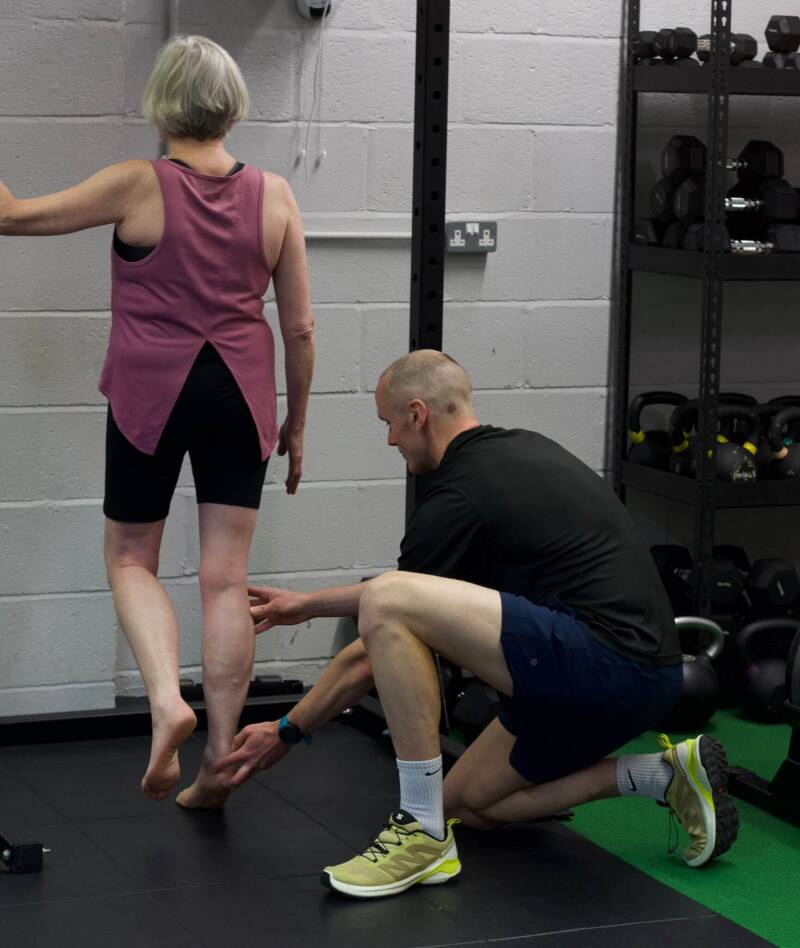
A physiotherapy assessment will look at both the tendon and the way your foot and lower limb function.
Your physiotherapist may assess:
-
The location and behaviour of your pain
-
Tenderness along the tendon
-
Ankle movement
-
Calf strength
-
Tibialis posterior strength
-
Single-leg heel raise capacity
-
Foot posture and arch height
-
Single-leg balance
-
Lower-limb strength
-
Walking and running mechanics
-
Your recent changes in activity
-
Previous ankle or foot injuries
One particularly useful functional test is the single-leg heel raise.
Difficulty performing repeated single-leg heel raises can indicate reduced calf and tibialis posterior capacity, although this test is interpreted alongside the rest of the assessment.
Tibialis Posterior Tendon Dysfunction and Flat Feet
The tibialis posterior tendon plays an important role in supporting the medial arch of the foot.
If the tendon becomes significantly weakened or lengthened, the arch may gradually lower and the foot may become more pronated.
This can be associated with:
-
A flatter-looking foot
-
The heel moving outwards
-
Increased outward movement of the forefoot
-
Difficulty performing a single-leg heel raise
-
Increasing pain or fatigue around the inside of the ankle
However, having flat feet does not automatically mean that you have tibialis posterior tendinopathy.
Foot shape varies naturally between individuals, and treatment should be based on symptoms and function rather than foot posture alone.
Stages of Tibialis Posterior Tendon Dysfunction
Tibialis posterior tendon problems are sometimes described in stages according to the degree of tendon dysfunction and changes in foot alignment.
Earlier stages may involve pain and reduced tendon capacity while the foot remains relatively well aligned.
More advanced problems can involve:
-
Progressive loss of arch height
-
Increasing foot pronation
-
Heel valgus
-
Difficulty performing a single-leg heel raise
-
Increasing stiffness
-
More widespread foot and ankle pain
More advanced or progressive cases may require assessment by an orthopaedic or foot and ankle specialist in addition to physiotherapy.
Tibialis Posterior Tendinopathy Treatment
Treatment is generally based around progressive loading of the tendon and the wider foot and ankle.
The aim is to improve the tendon’s ability to tolerate the loads required for walking, running, work and sport.
Load Management
Initially, activities that significantly aggravate symptoms may need to be modified.
This could involve temporarily reducing:
-
Running
-
Hill running
-
Long walks
-
Hiking
-
Jumping
-
Prolonged standing
Complete rest is not usually necessary.
Instead, the aim is to identify a level of activity that the tendon can tolerate while gradually rebuilding its capacity.
Tibialis Posterior Strengthening
Progressive strengthening is an important component of rehabilitation.
Exercises may include:
-
Resisted inversion
-
Resistance-band exercises
-
Seated calf raises
-
Standing calf raises
-
Single-leg heel raises
-
Heel raises with a ball or similar cue between the heels
-
Single-leg strengthening
-
Functional strengthening exercises
Exercises are gradually progressed by increasing resistance, repetitions, range of movement and functional demand.
Calf Strength
The calf muscles work closely with the tibialis posterior during walking, running and heel raises.
Reduced calf strength can increase the demands placed on the foot and ankle.
Rebuilding calf strength is therefore often an important part of rehabilitation.
Progression may include:
Seated calf raise → double-leg calf raise → single-leg calf raise → loaded single-leg calf raise
The exact progression depends on your current strength and symptoms.
Foot and Intrinsic Muscle Strength
The smaller muscles within the foot also contribute to foot stability.
Your rehabilitation may therefore include exercises designed to improve foot control and strength.
These may include:
-
Controlled arch exercises
-
Toe exercises
-
Single-leg balance
-
Foot strengthening
-
Functional weight-bearing exercises
The aim is not necessarily to maintain a rigid arch but to improve the foot's ability to adapt to and control load.
Orthotics and Footwear
Some people with tibialis posterior tendon problems benefit from temporary or longer-term changes to footwear or foot support.
This may include:
-
Supportive footwear
-
Temporary insoles
-
Custom orthotics in selected cases
-
Heel or arch support
Orthotics are not necessarily required for everyone.
They may be considered when the tendon is struggling to tolerate load or when foot mechanics are contributing significantly to symptoms.
They are generally most effective when used alongside progressive strengthening rather than as a replacement for rehabilitation.
Return to Running
If you are a runner, rehabilitation should eventually prepare the tibialis posterior tendon for the demands of running.
A gradual progression may involve:
Walking → jogging → continuous running → increased mileage → hills → faster running → intervals
Running volume should be progressed according to your symptoms and improving tendon capacity.
If your symptoms repeatedly flare after running, your current training load may be exceeding the tendon’s capacity.
How Long Does Tibialis Posterior Tendinopathy Take to Recover?
Recovery varies considerably between individuals.
Mild or relatively recent tendon problems may improve over several weeks, while longer-standing symptoms or significant tendon dysfunction can take several months to rehabilitate.
Factors that can influence recovery include:
-
Duration of symptoms
-
Severity of tendon dysfunction
-
Strength
-
Foot posture and mechanics
-
Training load
-
Occupational demands
-
Previous injuries
-
Ability to progressively load the tendon
Recovery should be judged by improvements in strength, function and tolerance to activity, rather than simply whether the tendon is completely pain-free.
Does Tibialis Posterior Tendinopathy Need an MRI or Ultrasound?
Imaging is not always required.
A clinical assessment can often identify whether the tibialis posterior tendon is likely to be contributing to your symptoms.
Imaging may be considered when:
-
Symptoms are persistent
-
The diagnosis is uncertain
-
There is significant weakness
-
A tendon tear is suspected
-
There are substantial changes in foot shape
-
Symptoms are not responding to appropriate rehabilitation
Ultrasound can assess the tendon and can provide dynamic information.
MRI can provide detailed information about the tendon, surrounding structures and the ankle and foot.
Imaging findings should always be interpreted alongside symptoms and clinical examination.
Tibialis Posterior Tendon Tear
A partial or complete tear of the tibialis posterior tendon can occur in more significant cases.
Symptoms may include:
-
Significant weakness
-
Difficulty performing a single-leg heel raise
-
Persistent pain and swelling
-
Increasing loss of arch support
-
Difficulty pushing off during walking
If a tendon tear is suspected, further assessment and potentially imaging may be appropriate.
When Should I See a Physiotherapist?
Consider physiotherapy assessment if you have:
-
Persistent pain around the inside of your ankle
-
Pain behind the medial malleolus
-
Pain when walking or running
-
Difficulty performing a single-leg heel raise
-
Increasing foot or ankle weakness
-
Recurrent swelling
-
A noticeable change in your foot shape
-
Increasingly flat arches associated with pain
-
Symptoms that are not improving despite reducing activity
Early assessment can help identify whether the tendon is simply overloaded or whether there are signs of more significant dysfunction.
Frequently Asked Questions
What is the fastest way to recover from tibialis posterior tendinopathy?
There is no single treatment that immediately resolves tibialis posterior tendinopathy.
The most important component is usually appropriately progressed strengthening combined with sensible management of activities that aggravate the tendon.
Should I rest with tibialis posterior tendinopathy?
Complete rest is not usually necessary.
Reducing activities that significantly increase symptoms can help initially, but the tendon generally needs progressive loading to rebuild strength and capacity.
Can I run with tibialis posterior tendinopathy?
Possibly, depending on the severity of your symptoms.
Some people can continue running with a modified training programme, while others need a temporary reduction or break from running.
Your physiotherapist can help determine an appropriate running load.
What exercises are best for tibialis posterior tendinopathy?
Progressive calf and tibialis posterior strengthening is usually central to rehabilitation.
Exercises may include resisted inversion, calf raises, single-leg heel raises and functional strengthening. The appropriate starting point depends on your current capacity.
Why does the inside of my ankle hurt when I walk?
Pain on the inside of the ankle can have several causes, including tibialis posterior tendinopathy, other tendon problems, ligament injuries, nerve irritation and joint problems.
An assessment is required to determine the most likely cause.
Can tibialis posterior tendinopathy cause flat feet?
Significant tibialis posterior tendon dysfunction can contribute to a progressive reduction in arch height.
However, naturally flat feet are common and do not necessarily indicate a tendon problem.
Do I need orthotics for tibialis posterior tendinopathy?
Not necessarily.
Some people benefit from temporary or longer-term foot support, particularly when the tendon is struggling to tolerate load. Orthotics should generally be considered as part of a wider rehabilitation programme rather than as a replacement for strengthening.
Can tibialis posterior tendinopathy be cured?
Many people significantly improve with appropriate load management and progressive rehabilitation.
More advanced tendon dysfunction or progressive changes in foot alignment may require longer-term management and, in some cases, specialist assessment.
When should I have an MRI?
MRI is not routinely required for straightforward tibialis posterior tendinopathy.
It may be appropriate when symptoms are persistent, the diagnosis is unclear or there is concern about significant tendon damage or another condition.
What happens if tibialis posterior tendinopathy is left untreated?
Some mild cases may settle with appropriate activity modification, but persistent tendon dysfunction can result in ongoing pain, weakness and reduced ability to support the foot.
In more advanced cases, progressive changes in foot alignment can occur. Persistent symptoms are therefore worth assessing rather than simply ignoring.
Tibialis Posterior Tendinopathy Physiotherapy in Newcastle
At NE Physio, we provide assessment and rehabilitation for tibialis posterior tendinopathy and other causes of medial ankle and foot pain in Newcastle.
We assess the tendon, foot and wider lower limb to understand why your symptoms have developed and how your current activity levels are affecting the tendon.
Your rehabilitation programme will be tailored to your goals, whether you want to return to running, get back to sport, improve your walking or reduce persistent ankle pain.
Book Your Assessment
If you have persistent pain around the inside of your ankle or suspect tibialis posterior tendinopathy, book an assessment with NE Physio in Newcastle.
Page Created and Reviewed by Clinician: Matthew Ivin PH 118421